QUEENSLAND
The following information is intended to serve as a practical resource to help guide you through the death of a loved one in Queensland. It is never easy when a person dies, and amidst the emotional weight of grief, it can be overwhelming to navigate the necessary steps and decisions. This information aims to provide clear steps, important tasks, contacts, and considerations—helping you focus on what matters most while ensuring essential matters are handled with care. The Australian Home Funeral Alliance provides this information as general knowledge and it is correct at the time of publishing.
Last updated June 2025.
This information has been provided by Ulick Baumann from Rest Funerals & Death Care.
What happens when someone dies in Queensland?
Knowing who to call is the first step when someone dies. In this blog, I’m going to let you know what to do, who to call and what happens next. Understanding the process will help you make informed decisions about your loved one’s care, and will let you know what you should expect from your funeral provider.
Don't be taken advantage of
When someone dies, the people left behind can be in a state of shock, grief and a general sense of overwhelm can cocoon them from the world around. So very often, whether intended or not, people are misled, misinformed, and taken advantage of. The best way to combat this is to have open conversations about death, the processes around death, and most importantly, being prepared for death.
The importance of choice
Every time someone chooses MyRest, I am reminded of why I founded this company – to provide guidance, respect and true choice when it matters most. While everyone’s situation will be so very different, I can appreciate how a family may feel during a time just after a death. I want those families to know that I will be ready to support them in any way I can, and give them space where it’s needed.
Breaking down the steps after someone dies
My goal for you, whether using MyRest or not, everything runs smoothly. While the article below refers to a Funeral Service Provider (FSP), please remember that this is your person and in Queensland there is no requirement to use a FSP for any part of the funerary process. Check out our FAQs to learn about this.
HANDY HINT: Download a copy of the Personal Details Form 2 from our website. Having this filled-in form is critical when the time comes. Whether you use MyRest, another FSP or handle the process yourself, this information is important to have ready to process the official Death.
Step by Step Process When Someone Dies
Stage 1. If your person dies at home, skip to Stage 3. If your person dies at hospital or an aged care facility, there is no need rush and call anyone - you have time.
Do not allow anyone to hurry you or to make decisions right now.
If they die in an aged care facility that doesn’t have a mortuary (most don’t), you have time to have a cup of tea and sit with your person for a couple of hours before starting to call around. Air Conditioning is more than enough at this stage.
Stage 2. A hospital will require the person making collection at the hospital to provide them with an Authority to Release (ATR) from the Next of Kin. The ATR is a way of the hospital transferring their responsibility for your person to either a funeral service provider (FSP) or mortuary transfer service. You can do this at any time - click here > Authority to Release 3. Aged care and hospice facilities vary in their processes so it may be best to find out in advance if planning a DIY funeral.
A doctor at the hospital will (and must within 48 hrs) provide a Form 9 - Cause of Death Certificate. The hospital will also not let a body leave without one. Go to Stage 4.
Stage 3. If your person dies at home, the circumstances leading up to the death will dictate what happens next. When a person is palliating (a terminal diagnosis and receiving only pain management) and/or local medical professionals are aware of the persons condition, the death should not be treated as an emergency. While in most cases, an ambulance is called, remember that;
• An ambulance is not required
• There is no immediate rush
• It can wait till morning to call your palliative nurse, GP, VAD Doctor or 000
When an ambulance is called, you can specify that the death is expected and there is no need for lights and sirens.
For all other deaths at home, a call to 000 is the first Stage. Queensland Ambulance Service (QAS), and often Police, will attend and provide a Life Extinct Form. The QAS examination will determine whether the death is reportable to the Coroner. Reportable deaths are those where;
• the identity of the person is unknown
• the death was violent or unnatural (eg. heart attack/vehicle accident)
• the death happened in suspicious circumstances
• the death was health care related
• cause of death (Form 9) is unlikely to be issued within 48 hours
• the death occurred in custody
• the death occurred in care
• the death occurred during or due to police operations
If QAS does not find the death to be reportable then they will usually advise that the Funeral Service Provider is called. Even if you are using such a service, there is no time frame set under Queensland law and you should not be pressured to do so immediately unless the situation with your person is unmanageable.
If your person is located in an awkward position (eg. the floor, outside etc...) ask QAS to assist in getting them to a location or position that suits you. While your person may be deceased, they should still be afforded the respect and dignity everyone deserves.
NB. Ensure the original Life Extinct Form stays with your person. Do not let QAS leave with the original form as it is required to transport your person until a Form 9 - Cause of Death Certificate is provided by a doctor.
If QAS finds the death to be reportable to the Coroner, skip to Stage 5.
Stage 4. If engaging a FSP, the next Stage is to contact them and arrange collection of your person or how they can help keep your person at home a little longer if you choose.
Stage 5. The FSP, or Government Contracted Undertaker (GCU) for reportable deaths, will arrive to collect your person. If the death was not a reportable one and has been collected by your FSP, skip to Stage 8.
Stage 6. Your person will be taken to the Coroner (usually in Brisbane or Southport). Once the Coroner has made their findings, the GCU will usually return your person to the nearest hospital to where they died. Sometimes they will be returned to a larger hospital due to capacity constraints*. This process
may take up to two or three weeks.
*The Coroner can make changes to their procedures at any time. The information here is based on our
experience Jan 2025.
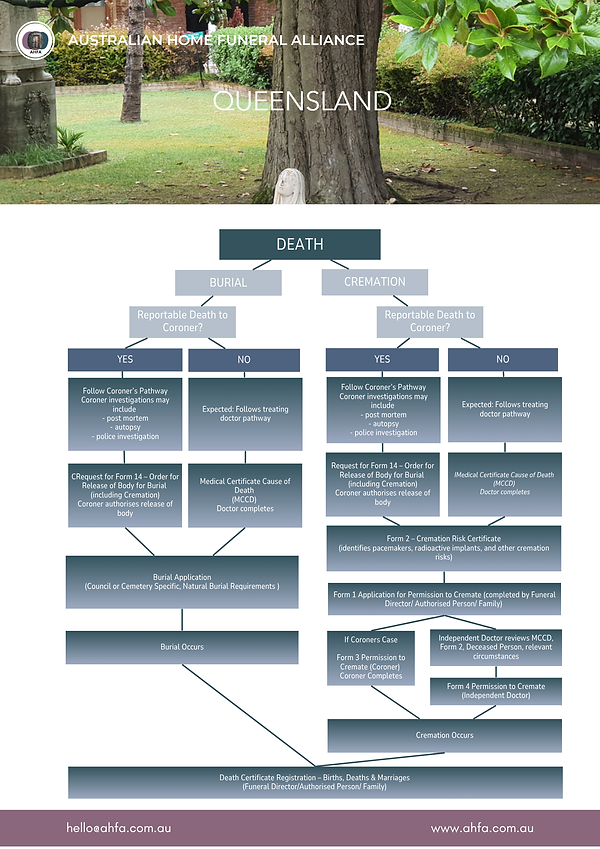
Stage 7. Your FSP will need to make application to the Coroner (REQUEST FOR FORM 14 - ORDER FOR RELEASE OF BODY FOR BURIAL (INCLUDING CREMATION). The FSP must provide the name of the person who engaged their services and the relationship to the deceased. This must match the information with the Coroner.
If your person is to be cremated, the FSP will also provide to the Coroner, Form 1 - Application for Permission to Cremate and the Coroner will provide them with Form 3 - Permission to Cremate.
Stage 8. Your person will be taken into care by your FSP. Between Stage 4 and now, the FSP will have organised a Form 9 - Cause of Death Certificate from either your person’s GP or a doctor at the hospital. If burial has been chosen, skip to Stage 10.
DIY TIP: It would be your responsibility to follow up with your person's GP to ensure the Form 9 - Cause of Death Certificate is produced and made available to you.
Stage 9. Your FSP will engage an independent doctor with a Form 1 - Application for Permission to Cremate. The independent doctor will visit the Funeral Service Provider's mortuary and examine the deceased body to ensure there is no cremation risk (eg. Batteries inside cardiac pacemakers or spinal stimulators pose an explosion risk at the crematorium). Once satisfied and/or any risks removed from the body, a Form 4 - Permission to Cremate (INDEPENDENT DOCTOR) will be provided. There is a fee associated with this service that is paid for by the FSP and passed on via the final invoice, whether listed or included in their professional fees.
DIY TIP: You would be responsible for arranging a doctor to do this for you.
Stage 10. Whether a funeral has been organised in advance or not, now is the time the FSP will book the cemetery/crematorium. This is usually called an Application for Burial, Order for Cremation or something similar.
A reminder now to ensure that the Personal Details Form is completed. This information can be lodged once your person has been buried or cremated and any delay in this information being provided to the FSP (or BDM directly if handling yourself), will result in a delay in processing the official Death Certificate from BDM.
Stage 11. On the day of burial/cremation, your person is transported to the facility where the burial/cremation takes place according to the funeral arrangements. If your person is to be buried, skip to Stage 13.
Stage 12. Anywhere from around 3 days onward, your ashes may be collected or returned. Collection can usually happen from around 3 business days and the name of the person collecting the ashes must be named in the Cremation Application (or the FSP can provide another name to the crematorium if
necessary). The timeframe for returning ashes will depend on how they are returned. Most FSP will offer a postage service at a reasonable rate.
Stage 13. Anywhere from 2-4 weeks, the official Death Certificate should arrive. At MyRest we usually have this document sent directly to the applicant (most likely you, reading this article). Some FSP will have it sent to them where you will collect it.
Stage 14. Here at MyRest, I will check in with our client’s family to see that they have received the official Death Certificate. As a general rule (every situation is different), it is my belief that while providing contacts to client’s family - such as that of grief specialists - it is not my place to keep checking in. I am always available to anyone (whether they have used MyRest or not) and always happy to talk and provide information. That said, a call from us could be triggering for some people.
Summing up
While all this information may seem a little clinical, MyRest’s goal is to give you all the information you need to make decisions that are right for you. Understanding the process gives you knowledge and empowers you to ensure you are treated fairly, ethically, and lawfully.
If you do engage MyRest, please know that I, Ulick Baumann (and any member of my small but mighty team), will treat your person with care and dignity.
Here is a review of the forms you may encounter. You can find most of them under the RESOURCES tab in the section FORMS.
• Form 1 - APPLICATION FOR PERMISSION TO CREMATE
• Form 3 - PERMISSION TO CREMATE (CORONER)
• Form 4 - PERMISSION TO CREMATE (INDEPENDENT DOCTOR)
• Form 8 - Death registration application
• Form 9 - CAUSE OF DEATH CERTIFICATE
• (REQUEST FOR FORM 14 - ORDER FOR RELEASE OF BODY FOR BURIAL (INCLUDING CREMATION)
• Form 14 - ORDER FOR RELEASE OF BODY FOR BURIAL (INCLUDING CREMATION)
This information has been provided by Lisa Herbert from The Bottom Drawer Book
In the case of an Expected death, Cremation
-
Call police, ambulance or patient’s doctor. Paramedics, registered nurse or doctor will complete a ‘life extinct form’. (Police can only issue Life Extinct Form in some circumstances (‘obvious deaths’). The above will help you contact the person’s doctor or health care representative to issue a ‘cause of death certificate’ (Form 9).
-
In Queensland, a death needs to be registered within 14 days from the date of death. It’s free to do and you can order and pay for a certificate at the same time.
You will need: Death registration application (Form 8). -
Apply for death certificate via Births, Deaths and Marriages. There is a fee involved.
-
THE CREMATION ITSELF:
An application can be made to an independent doctor:
Form 1 ‘Application for a permission to cremate’ (Section 6 (1) ).
A copy of the ‘cause of death certificate’ (Form 9) is needed here too, and,
Form 2 - Cremation risk certificate (unless the cause of death certificate was not issued in Queensland and a cremation risk certificate has not been issued). -
The independent doctor may give permission to cremate by issuing a Form 4 (Cremations Act) – Permission to cremate. The doctor must be satisfied the death is not a reportable death and there is no cremation risk.
-
If an independent doctor issues ‘a permission to cremate’, the doctor must arrange for the application for permission to cremate, including any documents accompanying the application, to be given to the person in charge of the crematorium where the deceased person is cremated.
-
The Law handbook says "Generally, following an approval, the deceased’s body will be released to the family so that they can organise the funeral. In practice, the funeral director will usually collect the body from the mortuary and prepare for burial or cremation. Sometimes family members collect and transport the body themselves to reduce conveyance costs." Source: Queensland Law Handbook
-
Once you have the:
-
Cause of death certificate (Form 9)
-
Permission to cremate,
-
a cremation can be carried out.
-
Transportation to the crematorium: In Qld, there is ambiguity around keeping the deceased at home and transportation. Unlike in some other states, there is no mention of this in any legislation or regulation. While there is nothing that says you can, there is nothing that says you can’t. Approaches to police and the health department have shed no light. They have been unable to answer queries about this either. It is unclear whether transportation liability insurance is needed. Talk to your insurance provider.
Note - May be best to make an official request for clarification (and a regulation update) to the Qld Premier, bypassing the health and police departments who have been unable to assist to date.
Also, ask for clarification (and a regulation update) regarding the release of the deceased from state-run hospitals into family care.
In the case of an expected death, Burial
-
Call police, ambulance or patient’s doctor. Paramedics, registered nurse or doctor will complete a ‘life extinct form’. (Police can only issue Life Extinct Form in some circumstances (‘obvious deaths’). The above will help you contact the person’s doctor or health care representative to issue a ‘cause of death certificate’ (Form 9).
-
In Queensland, a death needs to be registered within 14 days from the date of death. It’s free to do and you can order and pay for a certificate at the same time.
You will need: Death registration application (Form 8). -
Apply for death certificate via Births, Deaths and Marriages. There is a fee involved.
-
Transportation to the burial ground: In Qld, there is ambiguity around keeping the deceased at home and transportation. Unlike in some other states, there is no mention of this in any legislation or regulation. While there is nothing that says you can, there is nothing that says you can’t. Approaches to police and the health department have shed no light. They have been unable to answer queries about this either.
It is unclear whether transportation liability insurance is needed. Talk to your insurance provider.
Note - May be best to make an official request for clarification (and a regulation update) to the Qld Premier, bypassing the health and police departments who have been unable to assist to date.Also, ask for clarification (and a regulation update) regarding the release of the deceased from state-run hospitals into family care. -
Qld has private and local government-run cemeteries. Each will have its own policies and booking forms.
Paperwork requirements are:-
a Certificate of Right of Burial or an Application for gravesite/burial or a similar form. (This form is from the cemetery operator itself eg. council)
-
the “Form 9 – Cause of Death Certificate” (or interstate equivalent).
-
-
Not all cemeteries will allow a funeral to be conducted without a funeral director e.g. all Brisbane City Council cemeteries *
-
An example of some of the requirements that may be encountered when seeking a family-led funeral:
Gold Coast Council allows funerals without a funeral director however:-
a permit must be applied for because of a bylaw that stipulates that a Person must not, unless authorised by a permit carry on the business of a funeral director.
-
anyone conducting business on Council sites must hold public liability insurance ($20 million) with the City of Gold Coast listed as an interested party. This is a condition of the permit that would be awarded to carry out a gravesite/ burial.
-
If these criteria were met, an induction with a council representative would be required. This induction would include safety around the burial set up. I.e., how to carry on a coffin to the site and onto the lower device, how to lower the coffin (or hand lower if that is what they choose) how to hand back fill etc.
-
In the case of an unexpected death, Cremation
-
Call police, ambulance or patient’s doctor. Paramedics, registered nurse or doctor will complete a ‘life extinct form’. Police can only issue Life Extinct Form in some circumstances (‘obvious deaths’.) The above will help you contact the person’s doctor or health care representative to issue a ‘cause of death certificate’.
-
If the doctor is unable to establish a probable medical cause, they or the police will make a report to Coroner in writing (Form 1 for police, form 1A for hospitals/doctors.) This is known as a ‘reportable death’.
Once notified, the coroner will decide whether a coronial investigation is required.(Coronial Family Services counsellors 1800 449 171 can offer support to next of kin at this time. -
If an investigation is carried out, a report will be sent to family, outlining the cause of death. A form showing the cause of death will be forwarded to the Registry of Births, Deaths and Marriages. Once this happens the death is officially registered, and a death certificate will be issued.
Submit a “Request for Form 14 – Order for release of body for burial (including cremation)” (Coroners Act 2003). This form is forwarded to the coroner investigating a death.
At the same time, submit the Application for a Permission to Cremate (Form 1 – Cremations Act 2003)
The coroner may give permission to cremate by issuing a Form 3 – Permission to cremate (coroner)****. This may occur when the coroner authorises the release of the deceased person and is satisfied there is no cremation risk.
Note: ****these form notes in brackets are important in Qld as there are similar forms relating to different Acts. -
Coroner clears body for release on Form 14 (Coroners Act), usually to Funeral Director but can be the executor of will/next-of-kin – depending on the cause of death may be subject to adequate storage facilities*.
A copy of this order must be forwarded by the Coroner to the Registrar General, Births, Deaths and Marriages (section 97 of the Coroners Act 2003). The form shows the medical cause of death. The form allows the Registry of Births Deaths and Marriages to officially register the death. The family then applies for a copy of the death certificate from the Registry of Births Deaths and Marriages.
Note: The Law handbook says "Generally, following an approval, the deceased’s body will be released to the family so that they can organise the funeral. In practice, the funeral director will usually collect the body from the mortuary and prepare for burial or cremation. Sometimes family members collect and transport the body themselves to reduce conveyance costs." Source: Queensland Law Handbook -
Once you have the:
-
Cause of death certificate
-
Permission to cremate
-
And the Coroner’s Form 14**, a cremation can be carried out.
-
-
Transportation to the crematorium: In Qld, there is ambiguity around keeping the deceased at home and transportation. Unlike in some other states, there is no mention of this in any legislation or regulation. While there is nothing that says you can, there is nothing that says you can’t. Approaches to police and the health department have shed no light. They have been unable to answer queries about this either.
It is unclear whether transportation liability insurance is needed. Talk to your insurance provider.
Note: It may be best to make an official request for clarification (and a regulation update) to the Qld Premier, bypassing the health and police departments who have been unable to assist to date. Also, ask for clarification (and a regulation update) regarding the release of the deceased from state-run hospitals into family care. -
Queensland has privately owned and local government-owned and run crematoriums. Each will have its own policies and booking forms. Private cremation requests will likely be assessed on a case-by-case basis. Generally, the deceased must be enclosed in a coffin, the minimum to be a cardboard coffin.
In the case of an unexpected death, Burial
-
Call police, ambulance or patient’s doctor. Paramedics, registered nurse or doctor will complete a ‘life extinct form’. (Police can only issue Life Extinct Form in some circumstances (‘obvious deaths’). The above will help you contact the person’s doctor or health care representative to issue a ‘cause of death certificate’ (Form 9).
-
If the doctor is unable to establish a probable medical cause, they or the police will make a report to Coroner in writing (Form 1 for police, form 1A for hospitals/doctors.) This is known as a ‘reportable death’.
Once notified, the coroner will decide whether a coronial investigation is required.
(Coronial Family Services counsellors 1800 449 171 can offer support to next of kin at this time. -
If an investigation is carried out, a report will be sent to family, outlining the cause of death. A form showing the cause of death will be forwarded to the Registry of Births, Deaths and Marriages. Once this happens the death is officially registered, and a death certificate will be issued.
-
Submit a “Request for Form 14 – Order for release of body for burial (including cremation)” (Coroners Act 2003). This form is forwarded to the coroner investigating a death.
Coroner clears body for release on Form 14 (Coroners Act), usually to Funeral Director but can be the executor of will/next-of-kin – depending on the cause of death may be subject to adequate storage facilities*.
A copy of this order must be forwarded by the Coroner to the Registrar General, Births, Deaths and Marriages (section 97 of the Coroners Act 2003). The form shows the medical cause of death. The form allows the Registry of Births Deaths and Marriages to officially register the death.
Family then applies for a copy of the death certificate from the Registry of Births Deaths and Marriages.
Note: The Law handbook says "Generally, following an approval, the deceased’s body will be released to the family so that they can organise the funeral. In practice, the funeral director will usually collect the body from the mortuary and prepare for burial or cremation. Sometimes family members collect and transport the body themselves to reduce conveyance costs." Source: Queensland Law Handbook -
Transportation to the burial ground: In Qld, there is ambiguity around keeping the deceased at home and transportation. Unlike in some other states, there is no mention of this in any legislation or regulation. While there is nothing that says you can, there is nothing that says you can’t. Approaches to police and the health department have shed no light. They have been unable to answer queries about this either.
It is unclear whether transportation liability insurance is needed. Talk to your insurance provider.
Note - May be best to make an official request for clarification (and a regulation update) to the Qld Premier, bypassing the health and police departments who have been unable to assist to date. Also, ask for clarification (and a regulation update) regarding the release of the deceased from state-run hospitals into family care. -
For post-coronial burials: Cemeteries Administration must receive:
-
a Certificate of Right of Burial or an Application for gravesite/burial or a similar form. (This form is from the cemetery operator)
-
the “Form 14 – Order for Release of Body for Burial (including Cremation) (from the Coroner’s Office) (or interstate equivalent).
-
-
Not all cemeteries will allow a funeral to be conducted without a funeral director e.g. all Brisbane City Council cemeteries *
-
An example of some of the requirements that may be encountered when seeking a family-led funeral:
Gold Coast Council allows funerals without a funeral director however:-
a permit must be applied for because of a bylaw that stipulates that a Person must not, unless authorised by a permit carry on the business of a funeral director.
-
anyone conducting business on Council sites must hold public liability insurance ($20 million) with the City of Gold Coast listed as an interested party. This is a condition of the permit that would be awarded to carry out a gravesite/ burial.
-
If these criteria were met, an induction with a council representative would be required. This induction would include safety around the burial set up. I.e., how to carry on a coffin to the site and onto the lower device, how to lower the coffin (or hand lower if that is what they choose) how to hand back fill etc.
-
Resources
Qld End of Life Law Factsheet
Flowchart of Required Paperwork